
67 million pounds. One warehouse. Every year.
A morning at the Marin Food Bank — and what the numbers mean.
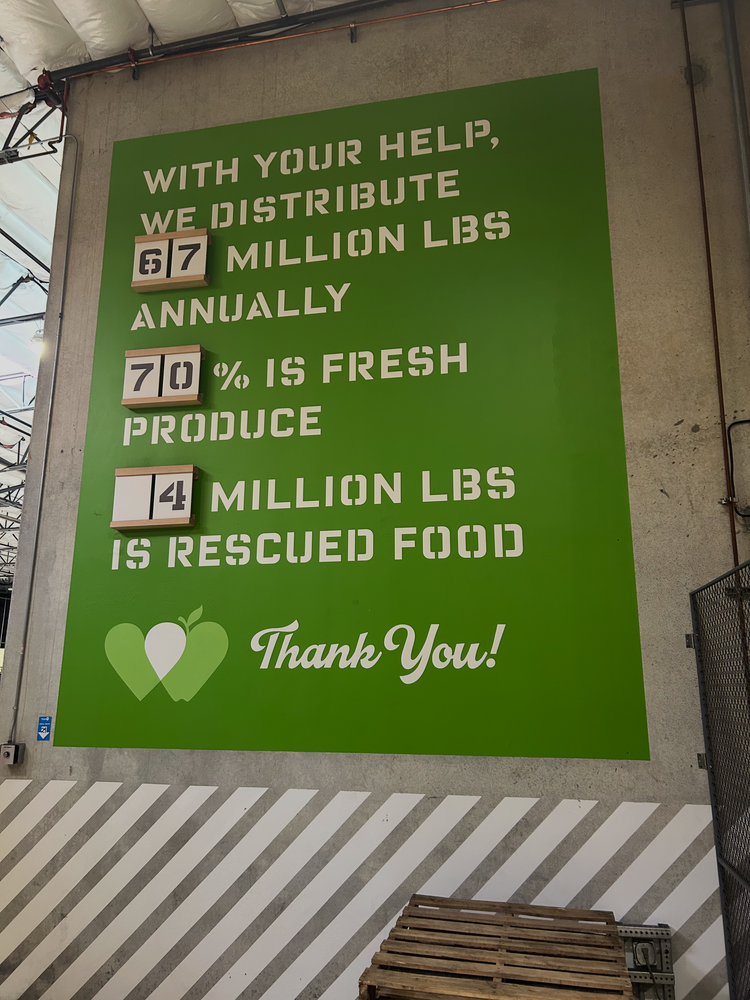
every year
not processed boxes
from going to waste
I volunteered at the Marin Food Bank this morning. The work is simple. You show up. You put on gloves. You help sort, pack, and move food so it can go out to the families who need it.
The sign in the volunteer area tells you what that work adds up to. Sixty-seven million pounds of food a year. Seventy percent of it is fresh produce — real fruit, real vegetables — not boxes of shelf-stable processed food. Four million pounds is rescued food: food that was about to be thrown away, saved and given to people who are hungry.
That is not a small thing. That is one county. One warehouse. One year.
Why the numbers matter
Almost 48 million Americans are food-insecure. That means they do not always know where their next meal is coming from. The national numbers have been going up since 2021. The price of groceries is up. The price of fertilizer is up. The U.S. cattle herd is the smallest it has been since 1951.
At the same time, Congress cut SNAP — the food stamp program — by nearly $200 billion. The USDA stopped doing its national food security survey. So we are managing a food crisis with less help and no scorecard.
Food banks like this one are going to be asked to do more in the years ahead, not less. Volunteers are going to matter more, not less. The people on my shift this morning were quiet, focused, and steady. No one was there for a photo opportunity. That is how the work gets done.
My platform connects to this. In March I published the Agricultural Resilience Imperative — a report with 14 ways Congress could strengthen food security. It is not a promise. It is a plan. You can read it on this site.
Who does the work
The Marin Food Bank does not run on one person. It runs on hundreds of regular volunteers, thousands of donors, and a small paid staff who keep it all moving. I also volunteer as a driver for A Simple Gesture, which picks up bags of food from people’s doorsteps and delivers them to the Food Bank. My next shift is May 2, 2026. I will post those field notes here too.
Politicians like to talk about “hard-working Americans.” These are hard-working Americans. They are in the warehouse at 8 a.m. on a Thursday. They are not looking for credit. I will not pretend I am one of them because I showed up once — I am not. I am a candidate for Congress who thinks the work they do matters, and I want you to see it.
What this page is
This is the first entry in my Field Notes. Going forward, I will post dated entries every time I do real work in the district — volunteer shifts, candidate forums, county visits, meetings with local leaders, media interviews. Every entry will have a date, a place, and a phone photo I took myself. No staging. No polished graphics. Just the record.
If you want to see what a “Show Your Work” campaign actually looks like on a regular Thursday, this is the page.
The Agricultural Resilience Imperative — March 2026
A 14-point congressional plan for American food security. Restore the USDA food security survey. Create 100,000 rural jobs through forest slash composting. Protect SNAP. Every point sourced. Every dollar accounted for.
Read the Plan →